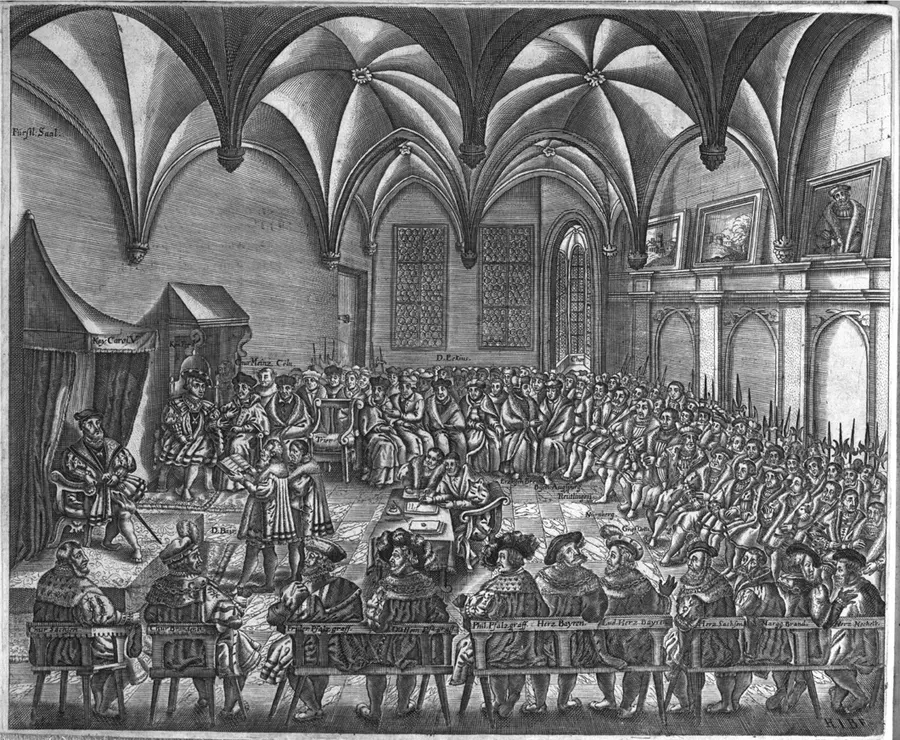
1530Lutheran princes present the Augsburg Confession to Charles V
By 1530 Martin Luther’s challenge to the Roman Church had split the Holy Roman Empire. The emperor Charles V, who also ruled Spain and much of Italy, wanted the quarrel settled so that the empire could stand united against the Ottoman Turks, and he summoned the princes and cities to an imperial diet at Augsburg. The Lutherans were asked to set out what they believed. Luther himself was an outlaw and could not attend, so the task fell to his colleague Philipp Melanchthon, who drew on earlier Lutheran statements to write a careful, conciliatory confession in 28 articles.
On 25 June 1530 the confession was presented to the emperor, in German and in Latin, by seven Lutheran princes and two free imperial cities. Catholic theologians answered it in August with a Confutation, and Charles refused to accept a further Lutheran reply, which Melanchthon expanded into his Apology of 1531. No reconciliation followed. But the Augsburg Confession became the founding statement of the Lutheran churches, and it is still their basic confession of faith today.
Read the full storyHistory & Timeline →Source: Britannica: Augsburg Confession ↗
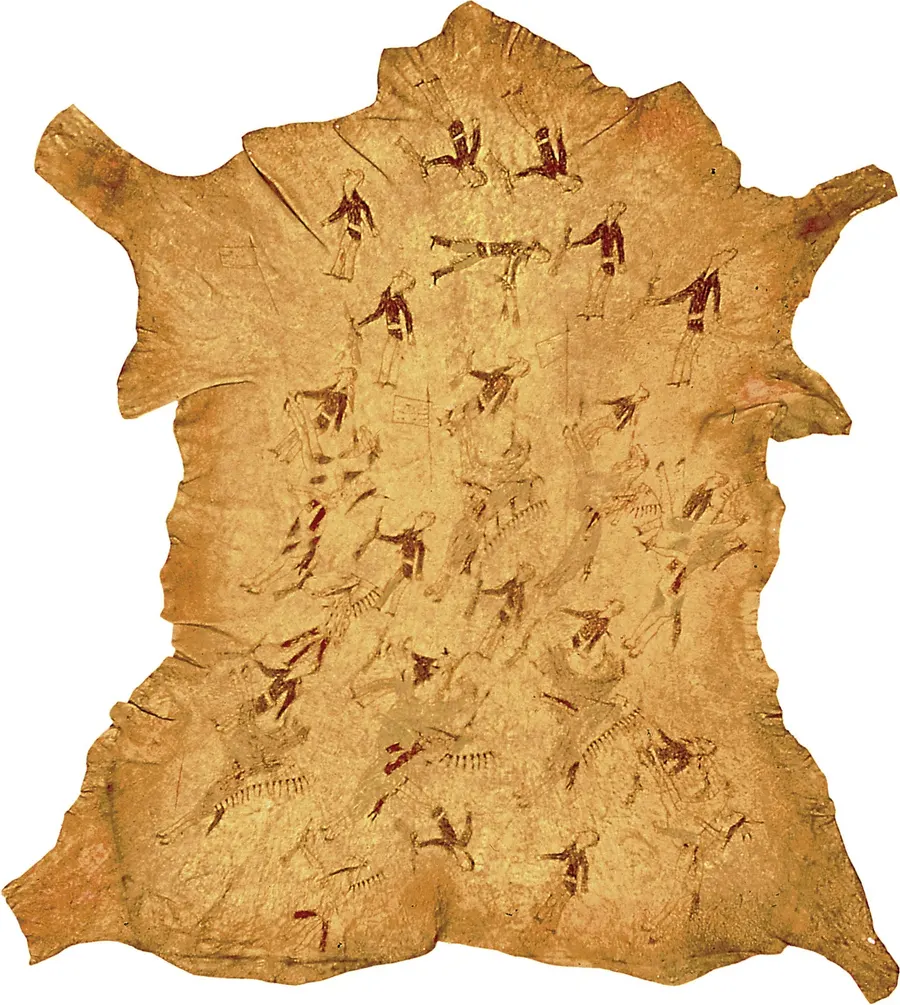
1876Lakota and Cheyenne warriors defeat Custer at the Little Bighorn
The Fort Laramie treaty of 1868 promised the Lakota the Black Hills, land sacred to them, for their own use. But after an army expedition led by George Armstrong Custer found gold there in 1874, prospectors poured in and the United States broke the treaty. Lakota and Cheyenne bands who refused to move onto reservations gathered around the spiritual leader Sitting Bull, and in 1876 the army sent columns of troops to force them in.
On 25 June 1876 Custer’s 7th Cavalry found a huge camp beside the Little Bighorn River in Montana Territory. Expecting the people to scatter, he split his regiment into three. Instead he faced perhaps 2,000 warriors, many armed with repeating rifles. Custer and the roughly 210 men who rode with him were cut off and killed, while the rest of the regiment held out on the hills to the south. It was the army’s worst defeat of the Plains wars, but a brief one for the victors: within a year most of the bands had been forced to surrender, and the Black Hills were taken.
Read the full storyHistory & Timeline →Source: National Park Service: Story of the Battle, Little Bighorn Battlefield ↗
1950North Korea invades the South and the Korean War begins
At the end of the Second World War Korea, a Japanese colony since 1910, was divided along the 38th parallel of latitude, with Soviet forces in the north and American forces in the south. By 1948 two rival states had been set up, the communist Democratic People’s Republic in Pyongyang and the Republic of Korea in Seoul, each claiming the whole peninsula.
In the early hours of 25 June 1950 the North Korean army crossed the parallel behind a heavy artillery barrage, with its main thrust aimed at Seoul. The attack took the South completely by surprise, and the capital fell within three days. The United Nations called on its members to help South Korea, and a US-led UN force was sent; later in the year China entered the war on the North’s side. The fighting ended in an armistice in July 1953 close to where it had begun, and no peace treaty has ever been signed.
Read the full storyHistory & Timeline →Source: Britannica: Korean War ↗
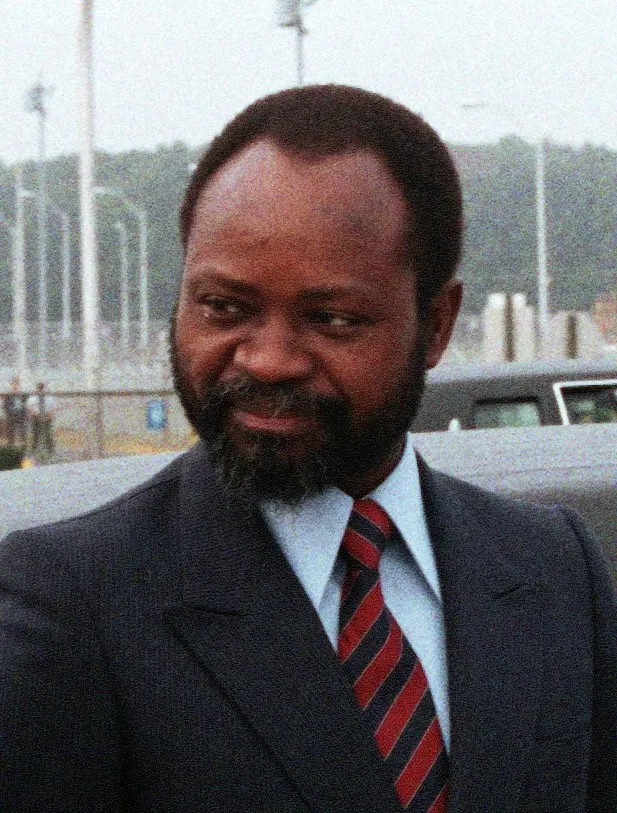
1975Mozambique becomes independent from Portugal
Portugal had ruled Mozambique for centuries, and in the 1960s, as most of Africa became free, its dictatorship refused to let go. Frelimo, the Mozambique Liberation Front, was formed under Eduardo Mondlane and began an armed struggle in 1964. After Mondlane was assassinated in 1969, Samora Machel, a former nurse who had become the movement’s military commander, took the lead in 1970.
The breakthrough came in Lisbon. In April 1974 a military coup overthrew the Portuguese regime, and the new government moved to withdraw from Africa. Frelimo negotiated a ceasefire and its right to govern, and on 25 June 1975 Mozambique became independent, with Machel as its first president. It was set up as a one-party state and followed a Marxist course, nationalising much of the economy. Independence Day is still Mozambique’s national day.
Read the full storyHistory & Timeline →Source: Britannica: Samora Machel ↗
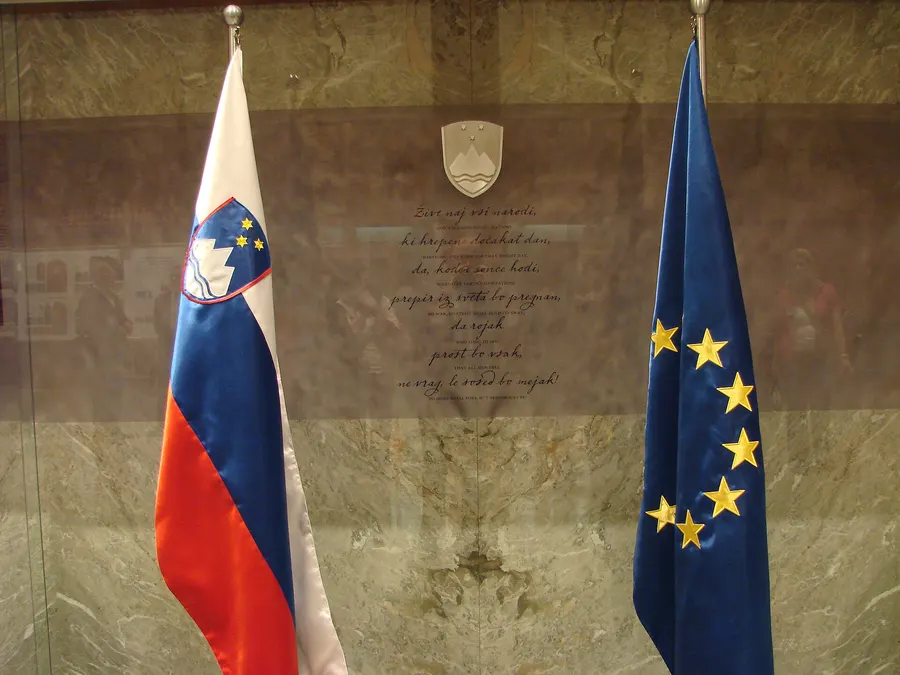
1991Slovenia and Croatia declare their independence from Yugoslavia
After the death of Tito in 1980, the six republics of communist Yugoslavia drifted apart. In 1990 Slovenia and Croatia held their first free elections, and their new governments proposed turning the federation into a looser confederation of sovereign states. Serbia, led by the nationalist Slobodan Milošević, rejected the idea.
On 25 June 1991 the parliaments in Ljubljana and Zagreb declared Slovenia and Croatia independent. Two days later the Yugoslav People’s Army attacked Slovene border posts, but Slovenia’s defence forces held their ground in what became known as the Ten-Day War, and the army soon withdrew. Croatia’s path was far bloodier, with a war against Serb forces that lasted until 1995. Germany’s early recognition of both states was followed by the rest of Western Europe in January 1992, and the break-up of Yugoslavia had begun.
Read the full storyHistory & Timeline →Source: Britannica: Slovenia since 1918 ↗