1858The first telegraph cable across the Atlantic comes ashore
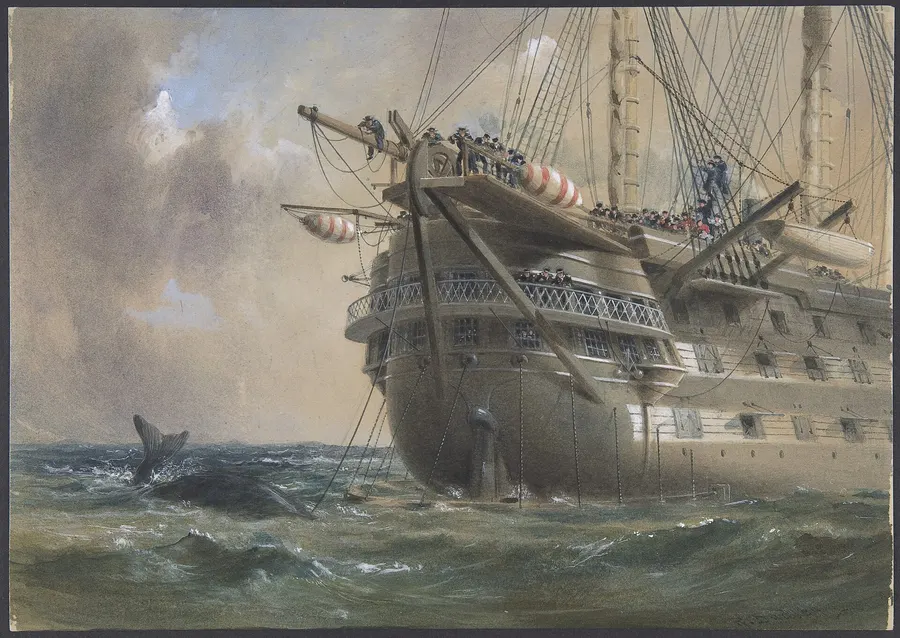
By the 1850s telegraph wires crossed Europe and North America, but news between the two still travelled by ship and took ten days or more. The American businessman Cyrus West Field set out to join them with a cable laid on the bed of the Atlantic, and with British and American backing two warships, HMS Agamemnon and USS Niagara, each carried half of it to sea. Two attempts in 1857 and early 1858 ended with the cable snapping and sinking.
In July 1858 the ships met in mid-ocean, spliced the two halves together and steamed away in opposite directions. On 5 August 1858 both ends were landed, at Trinity Bay in Newfoundland and at Valentia Island in Ireland, and Field’s shout of ‘The cable is laid!’ set off celebrations on both sides of the ocean. Messages crawled along at a few words a minute, and within weeks the signal faded and the cable failed. A lasting link came only in 1866, but the idea of near-instant contact across an ocean had been proved.
Read the full storyHistory & Timeline →Source: PBS American Experience: The Great Transatlantic Cable ↗
1960Upper Volta, today’s Burkina Faso, becomes independent
The land of the Mossi kingdoms in the bend of the Volta rivers was conquered by France in the 1890s. The French made it a separate colony, Upper Volta, in 1919, broke it up among its neighbours in 1932 to supply labour to the Ivory Coast, and put it back together in 1947. After the Second World War local politicians won a growing say in its affairs, and in 1958 it became a self-governing republic within the French Community.
Full independence came on 5 August 1960, one of a wave of French African colonies to go free that year, with Maurice Yaméogo of the Voltaic Democratic Union as president. Yaméogo soon banned opposition parties, and in 1966, after strikes and street protests, he was overthrown by the army under Lieutenant Colonel Sangoulé Lamizana. In 1984 the country took the name Burkina Faso, ‘land of upright people’.
Read the full storyHistory & Timeline →Source: US Department of State: Background Note, Burkina Faso ↗
1906The Shah of Persia agrees to an elected parliament
At the start of the 20th century Persia was ruled by the Qajar shahs, whose treasury was empty and who were selling concessions and borrowing heavily from Russia and Britain. Merchants, clergy and reformers blamed the court for the country’s weakness, and protests grew through 1905 and 1906. In the summer of 1906 leading clerics withdrew to the holy city of Qom, and thousands of people took sanctuary in the grounds of the British legation in Tehran, refusing to leave until they were given a ‘house of justice’.
On 5 August 1906 the ailing Mozaffar ad-Din Shah issued a decree granting an assembly of representatives. The protesters thought the first wording too vague, and a second decree followed a few days later, but the principle had been won. The first Majles opened in October, and the shah signed a constitution at the end of December, days before he died. Iran still remembers the date of the decree as Constitution Day.
Read the full storyHistory & Timeline →Source: Encyclopaedia Iranica: Constitutional Revolution, ii. Events ↗
1772Russia, Prussia and Austria agree the First Partition of Poland
In the 18th century the Polish-Lithuanian Commonwealth was one of the largest states in Europe, but its elected kings were weak and its parliament could be paralysed by the veto of a single deputy. Russia treated it as a protectorate, and when Polish nobles rose against Russian influence in the Bar Confederation of 1768, Catherine the Great’s armies crushed them. Prussia’s Frederick the Great and Austria, worried that Russia would gain too much, looked for shares of their own.
On 5 August 1772 the three powers signed their agreement at St Petersburg. Russia took the lands east of the Dvina and Dnieper rivers, Prussia took Royal Prussia, cutting Poland off from much of its coast, and Austria took the region that became Galicia. Poland lost almost a third of its territory and about half its people, and in 1773 its parliament was forced to ratify the loss. Two more partitions, in 1793 and 1795, wiped Poland off the map until 1918.
Read the full storyHistory & Timeline →Source: Britannica: Partitions of Poland ↗
2010A mine collapse traps 33 men deep under Chile’s Atacama Desert
The San José mine, a small copper and gold mine in the Atacama Desert about 80 kilometres from the city of Copiapó, had a long record of accidents. On the afternoon of 5 August 2010 a huge mass of rock collapsed inside it, sealing the only way out. Thirty-three miners were trapped about 700 metres below the surface, and for more than two weeks nobody above ground knew whether any of them were alive.
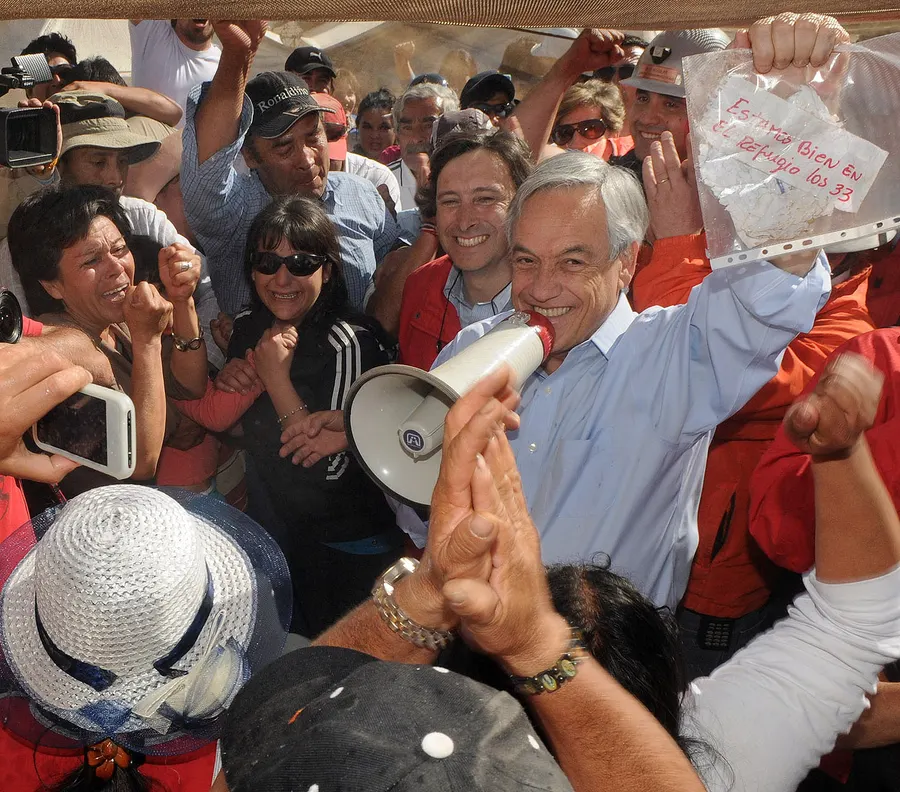
The men had reached a small emergency shelter, and they survived by rationing food meant to last two days. On 22 August a narrow probe drill broke into their space, and when it was pulled up it carried a note: ‘We are well in the shelter, the 33’. Food, water and messages were sent down through the borehole while wider shafts were drilled, with advice from NASA among many others. On 13 October all 33 were winched to the surface, one by one, in a capsule called the Fénix, as a worldwide television audience watched.
Read the full storyHistory & Timeline →Source: Britannica: Chile mine rescue of 2010 ↗