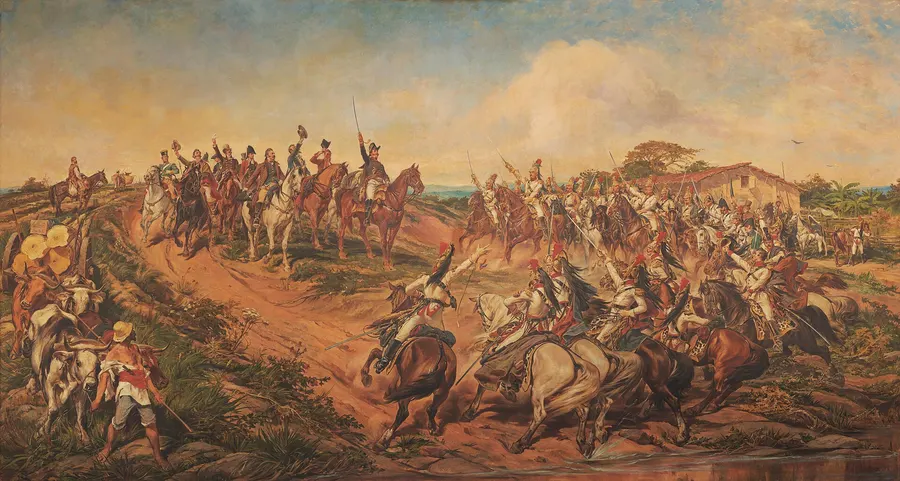
1822Prince Pedro declares Brazil independent by the Ipiranga stream
When Napoleon’s armies invaded Portugal in 1807, the Portuguese royal family fled to Brazil, and Rio de Janeiro became the capital of the empire. King João VI went home in 1821, leaving his son Pedro to govern Brazil as prince regent. The Portuguese parliament, the Cortes, then set out to reduce Brazil to a colony again and ordered Pedro back to Lisbon. In January 1822 he refused, declaring that he would stay, and Brazilian leaders such as José Bonifácio de Andrada urged him to go further.
On 7 September 1822 Pedro was riding back to São Paulo from the port of Santos when messengers caught up with him by the Ipiranga stream with letters from Lisbon and from Rio. The Cortes had annulled his decisions and was sending troops. According to the accounts of those with him, he tore the Portuguese emblem from his uniform and declared ‘Independence or death!’ Within weeks he was acclaimed Emperor Pedro I, and after fighting with Portuguese garrisons in the north, Brazil became the only independent monarchy in the Americas. The day is Brazil’s national holiday.
Read the full storyHistory & Timeline →Source: Britannica: Brazil, Independence ↗
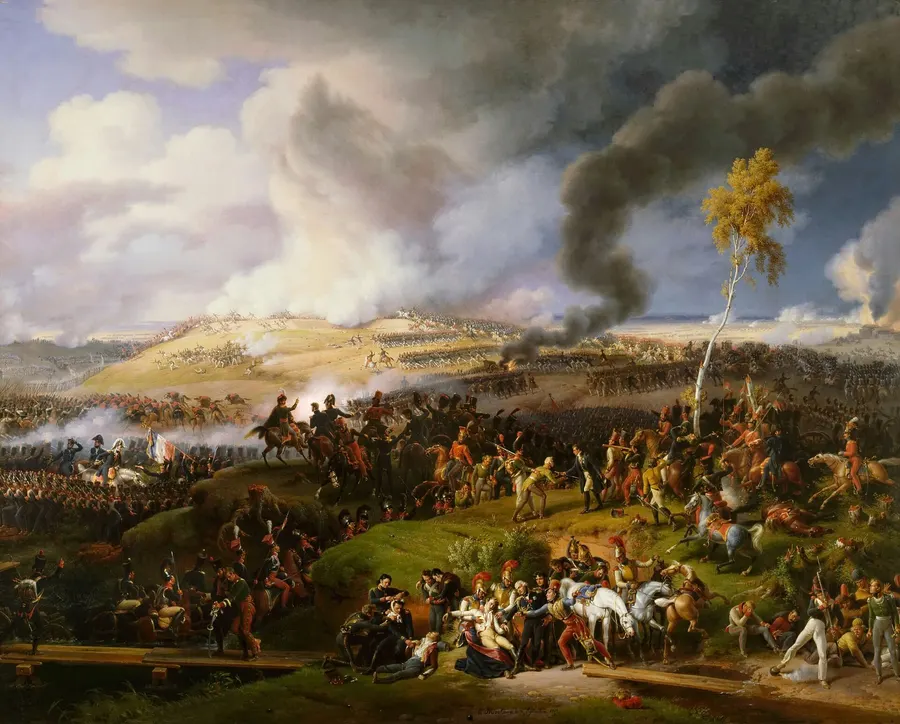
1812Napoleon and Kutuzov fight at Borodino
In June 1812 Napoleon led the largest army Europe had ever seen across the river Neman into Russia. The Russian armies fell back, burning crops and villages as they went, and for weeks Napoleon could not force the decisive battle he wanted. Under pressure to make a stand before Moscow, the veteran general Mikhail Kutuzov dug in near the village of Borodino, about 110 kilometres west of the city.
The battle was fought on 7 September 1812 (26 August in the Russian calendar of the time). Some 130,000 French and allied troops attacked about 120,000 Russians in a series of frontal assaults on earthworks such as the Raevsky redoubt, under fire from more than a thousand guns. By evening the Russians had been pushed back but not broken, and Napoleon had refused to send in his Imperial Guard. Estimates vary, but Britannica gives about 45,000 Russian and 30,000 French casualties in a single day. Kutuzov withdrew, and a week later Napoleon entered an almost empty Moscow, but the Russian army survived to drive him out of the country that winter.
Read the full storyHistory & Timeline →Source: Britannica: Battle of Borodino ↗
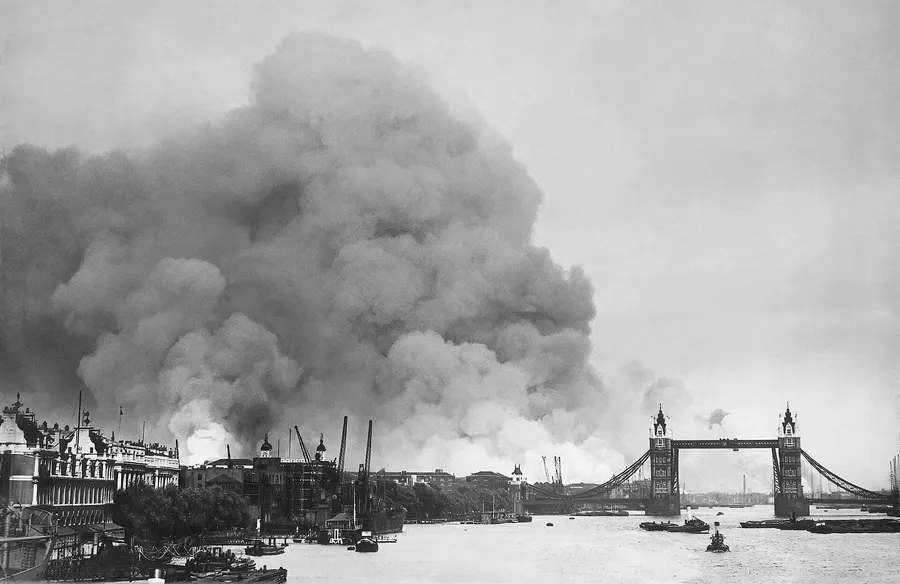
1940The Blitz begins with a mass raid on London
Through the summer of 1940 the German air force fought the RAF for control of the skies over southern England, attacking airfields and radar stations in preparation for an invasion. In early September Hitler and Göring changed course and ordered a direct assault on London, partly in reprisal for British raids on Berlin and partly in the hope of breaking Britain’s will to fight.
Late on the afternoon of Saturday 7 September 1940, around 350 bombers with some 600 fighters as escort flew up the Thames estuary. They set the docks, Woolwich Arsenal and the warehouses and crowded streets of the East End ablaze, and a second wave kept bombing by the light of the fires until the early morning. About 430 Londoners were killed and some 1,600 badly injured on what became known as Black Saturday. London was bombed on 57 consecutive nights that followed, and the Blitz went on to strike cities across Britain until May 1941, killing more than 40,000 civilians.
Read the full storyHistory & Timeline →Source: Imperial War Museums: The Blitz around Britain ↗
1191Richard the Lionheart defeats Saladin at Arsuf
In 1187 Saladin, sultan of Egypt and Syria, destroyed the army of the crusader kingdom of Jerusalem and took the holy city. The Third Crusade set out to win it back, and in July 1191 the crusaders, led by King Richard I of England, captured the port of Acre after a two-year siege. Richard then marched his army south along the coast towards Jaffa, the nearest port to Jerusalem, with his fleet alongside and his infantry shielding the knights from constant attacks by Saladin’s mounted archers.
On 7 September 1191, on the plain north of Arsuf, Saladin threw his whole army against the marching column, hoping to provoke the crusader knights into a disorderly charge. Richard held them back until the moment was right, though some of the Hospitallers broke ranks first, and the charge that followed scattered Saladin’s army. It was the only great pitched battle between the two leaders. Richard went on to take Jaffa, but he never reached Jerusalem, and a year later the two men agreed a truce.
Read the full storyHistory & Timeline →Source: Britannica: Richard I, king of England ↗
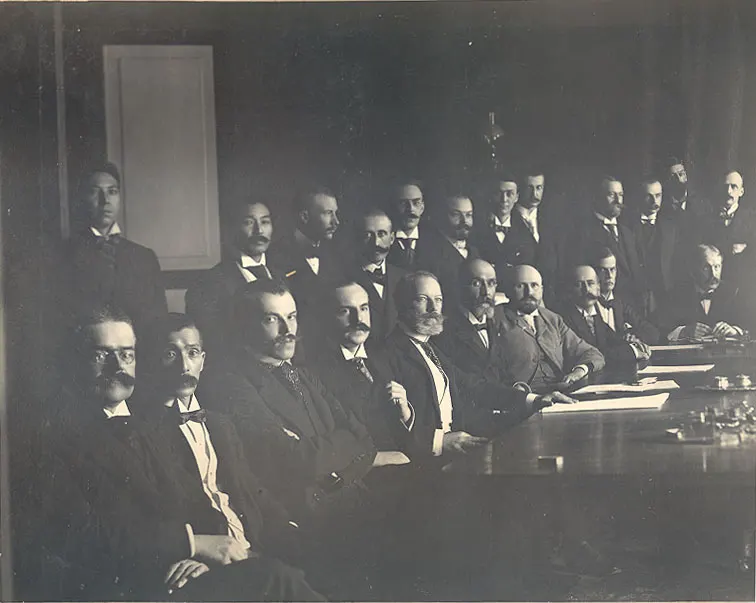
1901The Boxer Protocol is signed in Beijing
In 1899 and 1900 the Boxers, a secret society that blamed foreigners and Christian missionaries for China’s troubles, attacked missionaries, Chinese Christians and railways across the north of the country. With the backing of the Empress Dowager Cixi, imperial troops joined them in besieging the foreign legations in Beijing for 55 days, until an international force of eight nations relieved the city in August 1900 and the court fled west.
The settlement was signed in Beijing on 7 September 1901 by China and eleven foreign powers. China agreed to pay an indemnity of 450 million taels of silver over 39 years, to execute or punish officials who had supported the Boxers, to destroy the forts between Beijing and the sea and to allow foreign troops to guard the legation quarter. The humiliating terms weakened the Qing dynasty further, and it fell ten years later.
Read the full storyHistory & Timeline →Source: Britannica: Boxer Protocol ↗