
HISTORY & TIMELINE
14 August

A journey through
14 August in history

The story of 14 August runs from the Portuguese victory at Aljubarrota in 1385 to the ceasefire that ended the war in Lebanon in 2006. In between come the Mainz Psalter, the first printed book to carry its date and printers’ names, the garrison that claimed Tristan da Cunha, the relief of the legations in Peking, China’s entry into the First World War, the signing of America’s Social Security Act, the first Olympic basketball final, played in the rain in Berlin, the Atlantic Charter, the independence of Pakistan, the strike at the Lenin Shipyard in Gdańsk and the great North American blackout.

JUMP THROUGH TIME
II
THE MIDDLE AGES

Medieval History

Kingdoms, conflict, faith, power and the changing medieval world.

1385
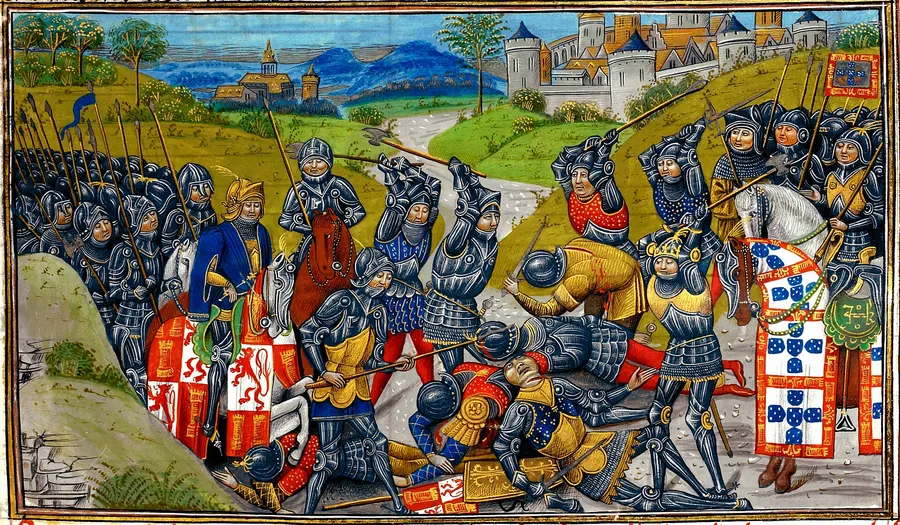
The Battle of Aljubarrota in a 15th-century illuminated manuscript of Jean de Wavrin's chronicle, now in the British LibraryThe Battle of Aljubarrota in a 15th-century illuminated manuscript of Jean de Wavrin’s chronicle, now in the British LibraryImage: Jean d'Wavrin (Chronique d'Angleterre) · Public domain
world · Europe

Portugal defeats Castile at Aljubarrota and keeps its independence

When King Ferdinand I of Portugal died in 1383, his only heir was his daughter Beatriz, who was married to King John I of Castile. Many Portuguese feared their kingdom would be swallowed by its larger neighbour. They rallied behind Ferdinand’s half-brother John, Master of the military Order of Aviz, and in April 1385 the Cortes at Coimbra proclaimed him king. The Castilian king invaded to claim the throne for his wife. On 14 August 1385 the two armies met near Aljubarrota, north of Lisbon. The Portuguese, led by John and his commander Nuno Álvares Pereira, were heavily outnumbered, but they held a strong defensive position and broke the Castilian cavalry; the king of Castile barely escaped. The victory secured Portugal’s independence and the Aviz dynasty. John built the great monastery of Batalha nearby in thanks.

Source: Britannica: Battle of Aljubarrota ↗
1457
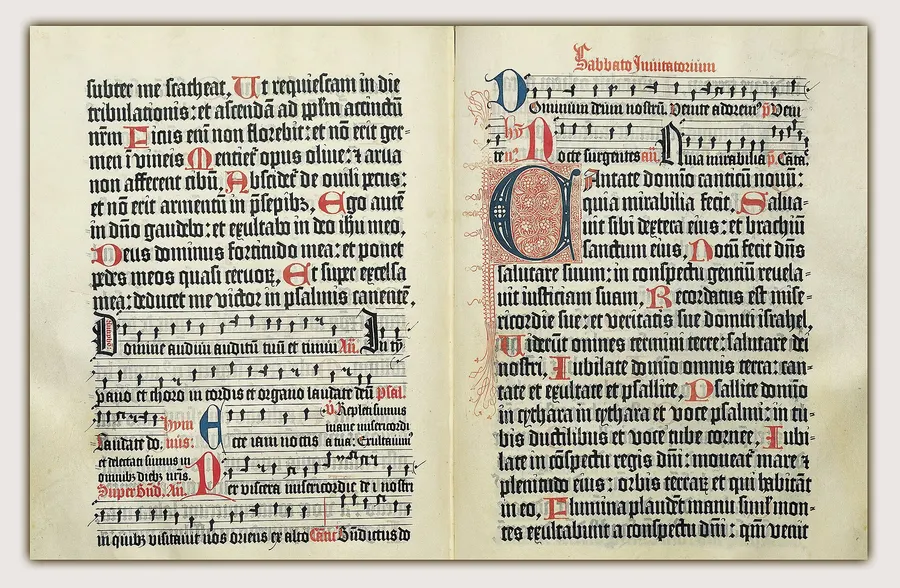
An opening of the Mainz Psalter, printed by Johann Fust and Peter Schöffer in 1457, with its red and blue initialsAn opening of the Mainz Psalter, printed by Johann Fust and Peter Schöffer in 1457, with its red and blue initialsImage: Johann Fust and Peter Schöffer (printers) · Public domain
culture · Europe

The Mainz Psalter becomes the first printed book to carry its date

Johannes Gutenberg had printed his Bible in Mainz in the mid-1450s, but he fell out with his financial backer, the merchant Johann Fust, who took over much of the workshop. With Gutenberg’s skilled assistant Peter Schöffer, Fust set out to print a book of psalms for church services that could rival the finest handwritten manuscripts. The Mainz Psalter was finished on 14 August 1457, the eve of the Feast of the Assumption, and its closing note, or colophon, says so. It was the first printed book to record its date, its place of printing and the names of its printers, and among the first to be printed in more than one colour, with large decorated initials printed rather than painted by hand. Only ten copies survive; one is in the Royal Library at Windsor.

Source: Royal Collection Trust: 10 greatest treasures of the Royal Library ↗
IV
THE NINETEENTH CENTURY

The 1800s

Industry, empire, invention, reform and a century of enormous transformation.

1816
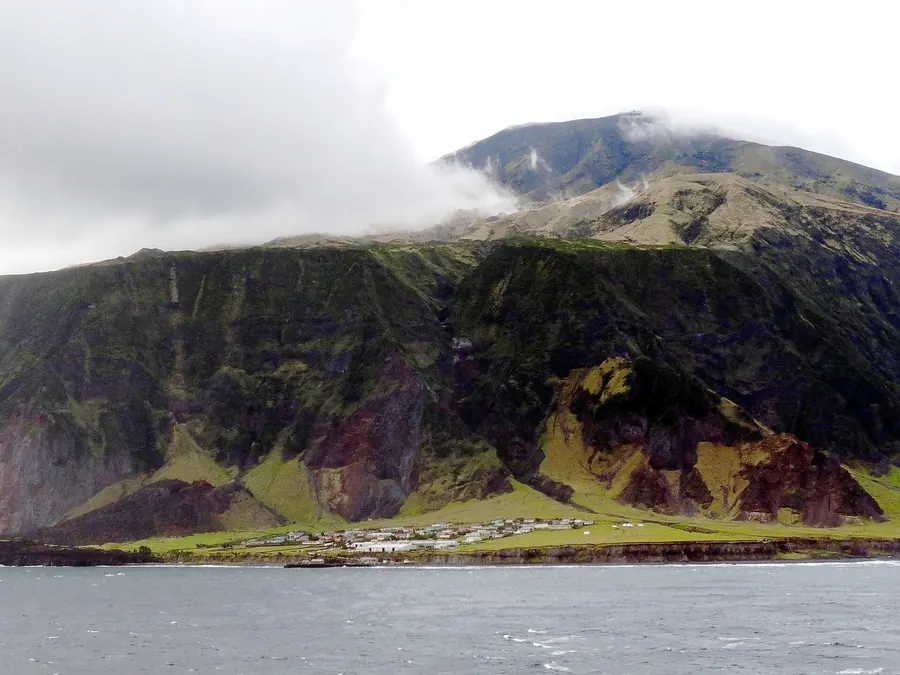
Tristan da Cunha from the sea, with the settlement of Edinburgh of the Seven Seas on the coastal plain below the volcanoTristan da Cunha from the sea, with the settlement of Edinburgh of the Seven Seas on the coastal plain below the volcanoImage: michael clarke stuff · CC BY-SA 2.0
politics · Africa

A British garrison takes possession of Tristan da Cunha

After Napoleon was exiled to St Helena in 1815, the British worried that the remote island of Tristan da Cunha, far to the south in the Atlantic, might be used by the French in a rescue attempt or by American ships. On 14 August 1816 a garrison landed from HMS Falmouth and took possession of the island for King George III. The soldiers left in 1817, but one of them, Corporal William Glass, stayed with his family and founded the community that still lives there.

Source: Tristan da Cunha Government: Discovery and settlement, 1506 to 1817 ↗
V
THE TWENTIETH CENTURY

The 1900s

War and peace, technological leaps, social change, politics, sport and popular culture.

1900
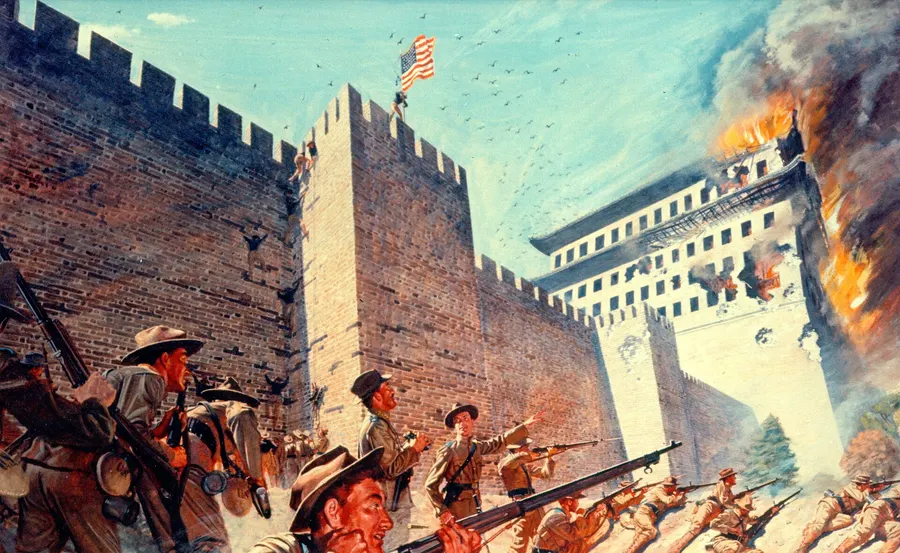
'I'll Try, Sir!', H. Charles McBarron's painting of American soldiers climbing the wall of Peking on 14 August 1900‘I’ll Try, Sir!’, H. Charles McBarron’s painting of American soldiers climbing the wall of Peking on 14 August 1900Image: H. Charles McBarron, Jr. · Public domain
world · Asia

An international force relieves the besieged legations in Peking

Since 20 June 1900 the foreign diplomats, their families and thousands of Chinese Christians in the legation quarter of Peking had been besieged by Boxer fighters and Qing troops. An allied force of soldiers from eight nations fought its way up from Tianjin and reached the city on 14 August 1900; American troops scaled the walls, while British soldiers got through a weakly defended gate and reached the legations first. The Empress Dowager Cixi fled the capital, and China was forced into a punishing peace settlement.

Source: Britannica: Siege of the International Legations (1900) ↗
1917
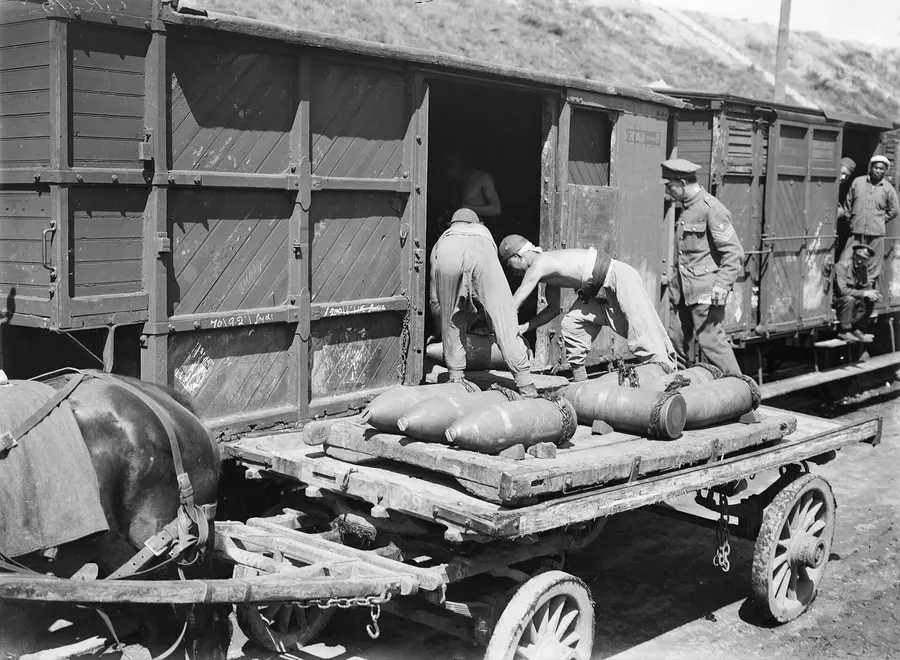
Men of the Chinese Labour Corps loading sacks at Boulogne, France, in August 1917Men of the Chinese Labour Corps loading sacks at Boulogne, France, in August 1917Image: Ernest Brooks · Public domain
world · Asia

China declares war on Germany and Austria-Hungary

China had stayed neutral in the First World War, though tens of thousands of Chinese labourers were already working behind the Allied lines in France. At 10 a.m. on 14 August 1917 the government in Peking declared war on Germany and Austria-Hungary and cancelled all its treaties with them. It hoped to win a voice at the peace conference and recover the German-held territory in Shandong, but in 1919 the peacemakers handed Shandong to Japan, setting off angry protests across China.

Source: US Office of the Historian: Foreign Relations of the United States, 1917, Supplement 1, document 653 ↗
1935
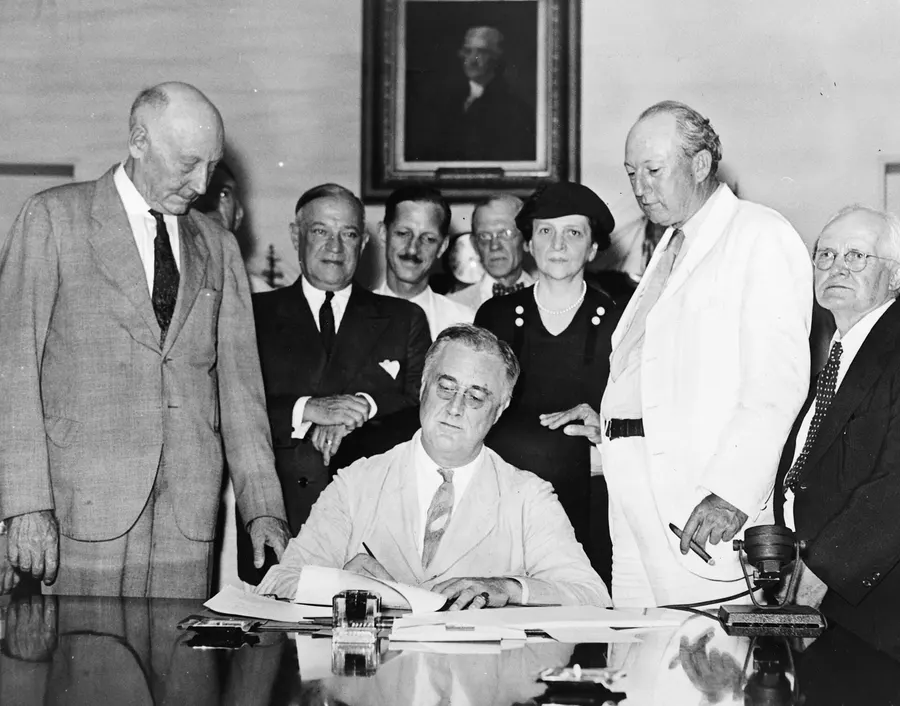
President Roosevelt signs the Social Security Act in the White House on 14 August 1935, with Frances Perkins standing behind himPresident Roosevelt signs the Social Security Act in the White House on 14 August 1935, with Frances Perkins standing behind himImage: Social Security Administration · Public domain
politics · Americas

Roosevelt signs the Social Security Act

In the depths of the Great Depression, millions of Americans had lost their jobs and many elderly people had no savings left. On the afternoon of 14 August 1935, in the Cabinet Room of the White House, President Franklin D. Roosevelt signed the Social Security Act, with his Labor Secretary Frances Perkins, its chief champion, standing behind him. The law created federal old-age pensions paid for by workers and employers, unemployment insurance and help for needy children, and became a cornerstone of American life.

Source: Social Security Administration: Historical background and development of Social Security ↗
1936
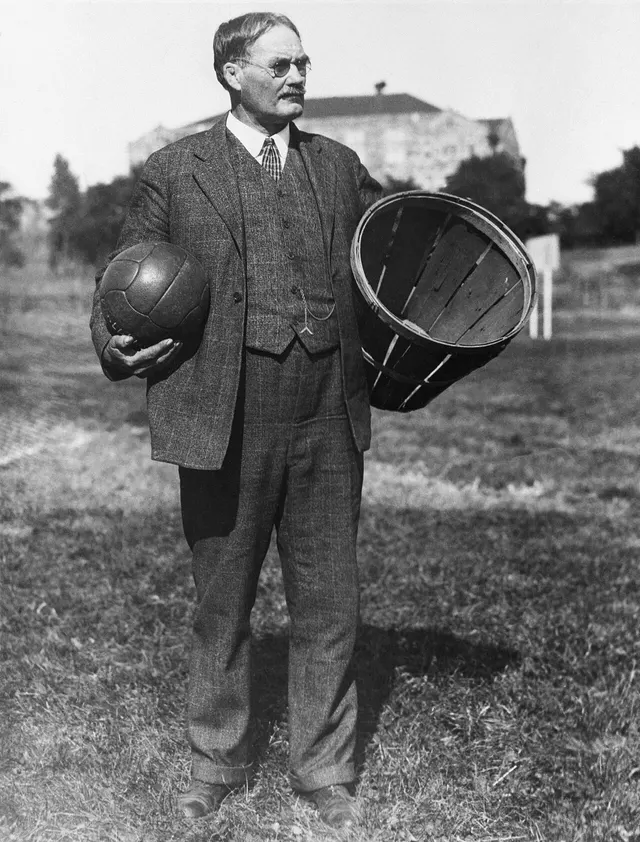
James Naismith, who invented basketball in 1891, with a ball and one of the first basketsJames Naismith, who invented basketball in 1891, with a ball and one of the first basketsImage: Unknown authorUnknown author · Public domain
sport · Europe

The first Olympic basketball final is played in the rain

Basketball, invented by James Naismith in Massachusetts in 1891, joined the Olympic programme for the first time at the Berlin Games of 1936. The tournament was played outdoors on clay courts, and the United States reached the final against Canada. The final on 14 August 1936 was played in pouring rain. The court turned to mud, the ball would hardly bounce and dribbling became almost impossible. The Americans led 15-4 at half-time, only eight points were scored in the whole second half, and the United States won 19-8, with Joe Fortenberry scoring eight.

Source: Olympics.com: Olympic basketball’s muddy beginnings ↗
1941
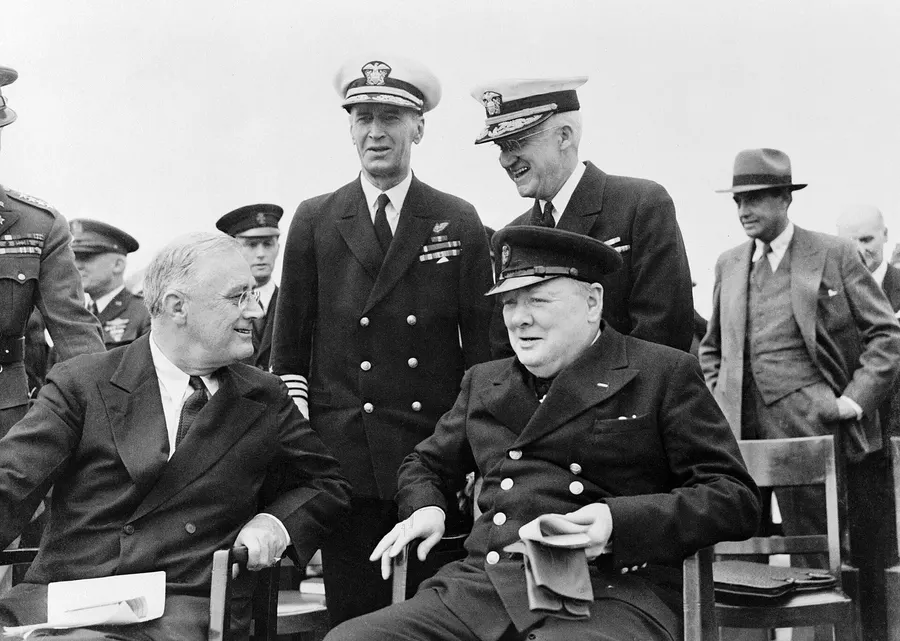
Franklin D. Roosevelt and Winston Churchill at a Sunday service on the quarterdeck of HMS Prince of Wales in Placentia Bay, 10 August 1941Franklin D. Roosevelt and Winston Churchill at a Sunday service on the quarterdeck of HMS Prince of Wales in Placentia Bay, 10 August 1941Image: Leslie Cornish Priest · Public domain
politics · Global

Churchill and Roosevelt publish the Atlantic Charter

In August 1941 Britain had been at war with Germany for almost two years, and the United States, though officially neutral, was sending it weapons and supplies under Lend-Lease. Winston Churchill crossed the Atlantic in the battleship HMS Prince of Wales, and from 9 August he and President Franklin D. Roosevelt met in secret aboard their warships in Placentia Bay, off Newfoundland, to talk about the war and the world that should follow it. On 14 August 1941 the two leaders released a joint declaration of eight ‘common principles’. Their countries would seek no new territory, respect the right of all peoples to choose their own government, work for freer trade and better labour and social standards, keep the seas free and disarm aggressor nations. The Atlantic Charter was not a treaty and was never formally signed, but it set out shared war aims months before America entered the fighting, and its ideas fed directly into the founding of the United Nations.

Source: US Office of the Historian: The Atlantic Conference and Charter, 1941 ↗
1947
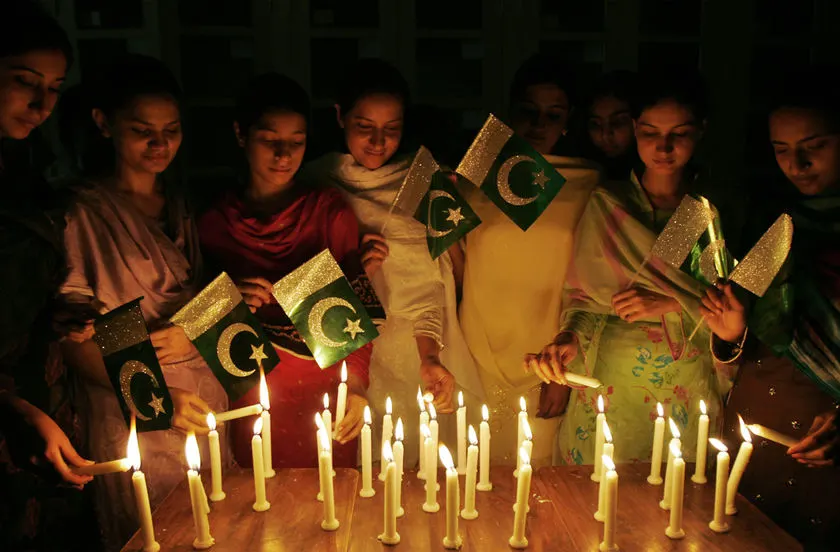
Young Pakistanis light candles and hold the national flag at a midnight celebration of Independence DayYoung Pakistanis light candles and hold the national flag at a midnight celebration of Independence DayImage: Khaum · CC BY 3.0
politics · Asia

Pakistan becomes an independent state

In British India, Muslims made up about a quarter of the population, and as the end of British rule came in sight many feared they would be a permanent minority in a Hindu-majority country. The All-India Muslim League, led by the Bombay lawyer Muhammad Ali Jinnah, called in its Lahore Resolution of 1940 for separate homelands in the Muslim-majority regions of the north-west and east. After the Second World War Britain decided to leave quickly, and in June 1947 the last viceroy, Lord Mountbatten, announced that the subcontinent would be divided. On 14 August 1947 Mountbatten addressed Pakistan’s new Constituent Assembly in Karachi, and the Dominion of Pakistan came into being, a day before India, with Jinnah as its first governor-general. The new state was made of two wings, West and East Pakistan, more than 1,500 kilometres apart. Partition brought one of the largest migrations in history, with millions crossing the new borders amid killings in which hundreds of thousands died. Pakistan celebrates 14 August as its Independence Day.

Source: Britannica: Independence Day (Pakistan) ↗
1980
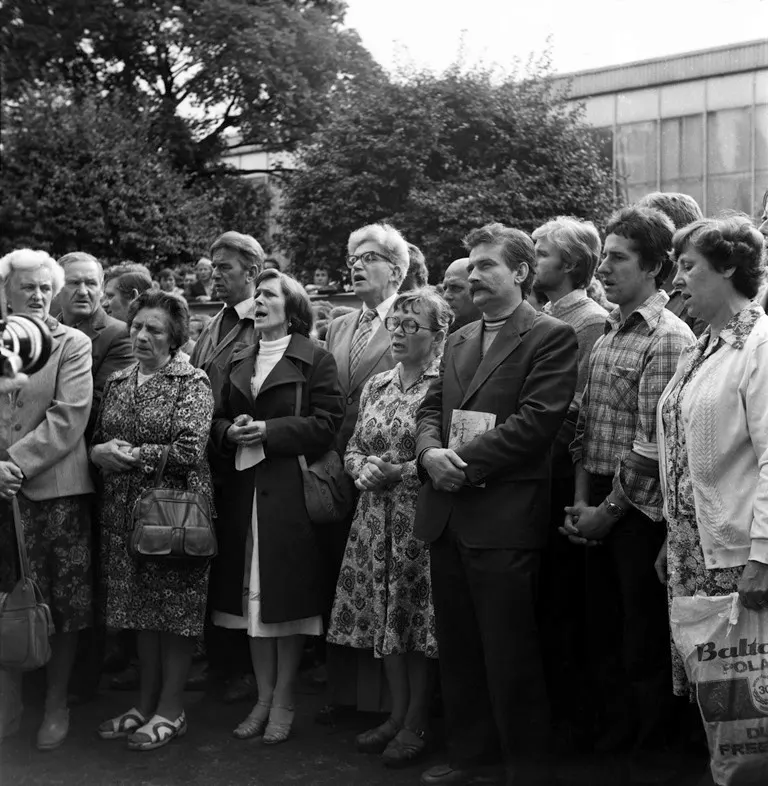
Strikers and supporters at an open-air Mass inside the Lenin Shipyard during the August 1980 strike; Lech Wałęsa and Anna Walentynowicz are among themStrikers and supporters at an open-air Mass inside the Lenin Shipyard during the August 1980 strike; Lech Wałęsa and Anna Walentynowicz are among themImage: Tadeusz Kłapyta · CC BY-SA 3.0 pl
politics · Europe

Workers at the Lenin Shipyard in Gdańsk go on strike

In the summer of 1980 rising food prices set off a wave of strikes across communist Poland. At the Lenin Shipyard in Gdańsk, on the Baltic coast, the crane operator Anna Walentynowicz, a well-known activist in the underground Free Trade Unions of the Coast, was dismissed on 7 August, only months before she was due to retire. Her fellow activists decided to answer with a strike. On the morning of 14 August 1980 the shipyard stopped work. The strikers demanded that Walentynowicz and the sacked electrician Lech Wałęsa be taken back, that pay be raised and that a memorial be built to the workers killed in the protests of December 1970. Wałęsa became the strike’s leader, other workplaces along the coast joined in, and an inter-factory committee drew up 21 demands. On 31 August the government signed the Gdańsk Agreement, which led to Solidarity, the first independent trade union in the Soviet bloc.

Source: European Solidarity Centre: How did Solidarność (Solidarity) come to be? ↗
VI
2000 TO TODAY

Modern Day

The events of recent decades that have already become part of the historical record.

2003
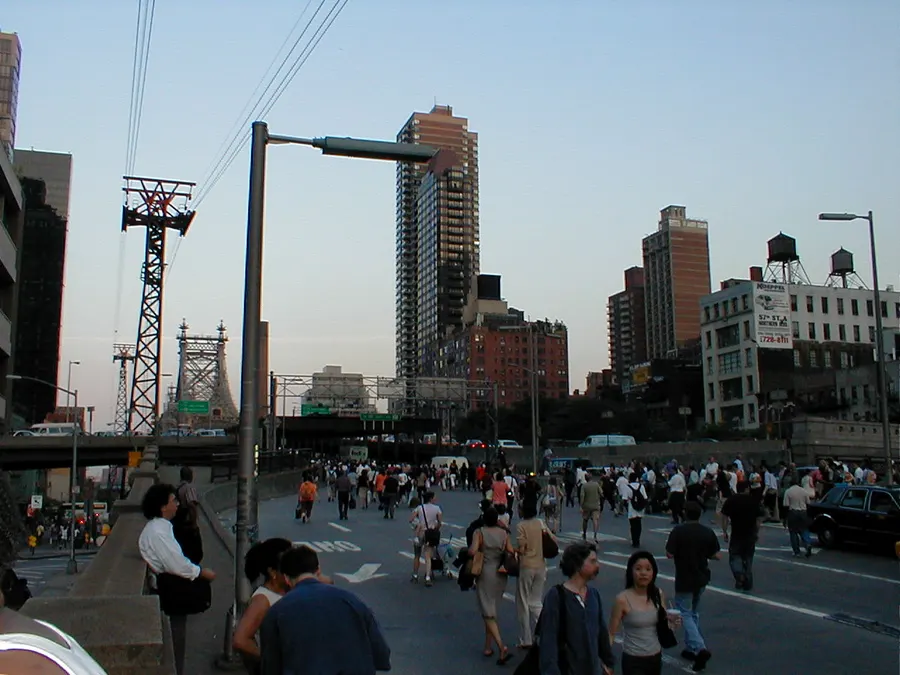
People on foot in the streets of Manhattan during the blackout of August 2003People on foot in the streets of Manhattan during the blackout of August 2003Image: Glitch010101 · CC BY-SA 2.0
science · Americas

A cascading failure blacks out 50 million people in North America

On the hot afternoon of 14 August 2003, several high-voltage lines in northern Ohio sagged into trees that had been left to grow too tall and shut down one after another. In the control room of the local utility, FirstEnergy, a computer alarm system had stopped working, and the operators did not realise how serious things were becoming. As the load shifted onto other lines, they too tripped. Shortly after 4 p.m. the failure cascaded through the interconnected grid within minutes. An area with about 50 million people, across large parts of the Midwest and Northeast of the United States and the Canadian province of Ontario, lost power. A joint US-Canadian task force later found that the blackout had been preventable and made 46 recommendations to make the grid more reliable.

Source: US Department of Energy: Final Report on the August 14, 2003 Blackout in the United States and Canada ↗
2006
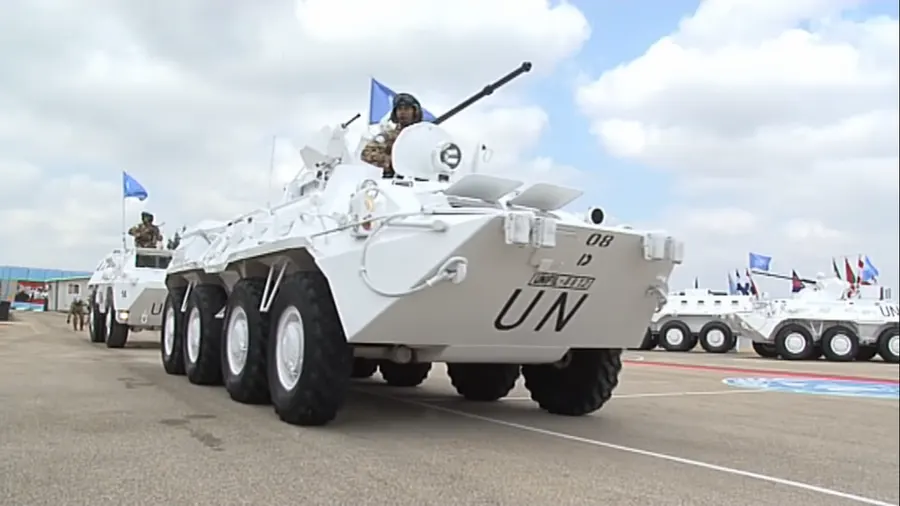
White-painted armoured vehicles of the Indonesian contingent of UNIFIL, the UN force in southern LebanonWhite-painted armoured vehicles of the Indonesian contingent of UNIFIL, the UN force in southern LebanonImage: Kontingen Garuda · CC BY 3.0
world · Middle East

A ceasefire ends the war between Israel and Hezbollah

On 12 July 2006 fighting broke out between Israel and Hezbollah, the armed Lebanese movement, and for 34 days Israeli forces struck Lebanon while Hezbollah fired rockets into Israel. On 11 August the UN Security Council unanimously passed Resolution 1701, calling for an immediate end to the fighting, and the cessation of hostilities took effect on 14 August 2006. The resolution called for Lebanese troops and UN peacekeepers to deploy together in southern Lebanon as Israeli forces withdrew.

Source: United Nations: Security Council calls for end to hostilities between Hizbollah and Israel, Resolution 1701 (2006) ↗
RESEARCH

Sources & Further Reading

Selected authoritative references supporting the events on this page.

Britannica: Battle of Aljubarrota↗Fundação Batalha de Aljubarrota: 1385, the Battle of Aljubarrota↗Royal Collection Trust: 10 greatest treasures of the Royal Library↗Princeton University Library: Inside the Milberg Gallery, survivals↗Tristan da Cunha Government: Discovery and settlement, 1506 to 1817↗Tristan da Cunha Government: Bicentenary of the British garrison, 1816 to 2016↗Britannica: Siege of the International Legations (1900)↗National Army Museum: The Boxer Rebellion↗US Office of the Historian: Foreign Relations of the United States, 1917, Supplement 1, document 653↗1914-1918-online: Governments, parliaments and parties (China)↗Social Security Administration: Historical background and development of Social Security↗National Archives, Forward with Roosevelt: August 14, a day of two anniversaries↗Olympics.com: Olympic basketball’s muddy beginnings↗FIBA: Olympic Games, Berlin 1936↗US Office of the Historian: The Atlantic Conference and Charter, 1941↗FDR Presidential Library and Museum: The Atlantic Charter↗Britannica: Independence Day (Pakistan)↗The National Archives (UK): Partition of British India↗European Solidarity Centre: How did Solidarność (Solidarity) come to be?↗Britannica: Lech Wałęsa↗US Department of Energy: Final Report on the August 14, 2003 Blackout in the United States and Canada↗Federal Energy Regulatory Commission: Power blackout↗United Nations: Security Council calls for end to hostilities between Hizbollah and Israel, Resolution 1701 (2006)↗UN News: Explainer, what is Security Council resolution 1701?↗
WHY THESE MOMENTS?

Significance before volume

This page is not the longest possible list of events. It is a chronological journey through 14 August, where each entry is chosen for historical significance, human interest and reliability.

Facts are checked against authoritative museums, archives, universities and reference works. Where sources disagree, the page says so.

EXPLORED THE DEEPER STORY?

Return to the highlights of 14 August

Discover the lighter side of the date with famous birthdays, culture, firsts and lives remembered.

Explore This Day →
← PREVIOUS DAY13 August
HISTORY & TIMELINE14 August
NEXT DAY →15 August