
HISTORY & TIMELINE
22 April

A journey through
22 April in history

From the election of Pope Gregory VII in 1073 to the Battle of Kapyong in 1951, 22 April has seen the Council of Constance end the Great Schism, the Sirius steam into New York, the Oklahoma Land Run, the great navies agree limits in London, the liberation of Sachsenhausen and Robin Knox-Johnston sail home from the first solo non-stop voyage round the world. This timeline follows the date across nearly nine centuries.

JUMP THROUGH TIME
II
THE MIDDLE AGES

Medieval History

Kingdoms, conflict, faith, power and the changing medieval world.

1073
Pope Gregory VII in a medieval Exultet roll from southern Italy.Pope Gregory VII in a medieval Exultet roll from southern Italy.Image: Unknown · Public domain
culture · Europe

Hildebrand is acclaimed Pope Gregory VII

On 22 April 1073, during the funeral of Pope Alexander II in Rome, a crowd of clergy and citizens shouted for the archdeacon Hildebrand to succeed him. He was installed the same day as Gregory VII, although he was not yet a priest. His insistence that popes, not kings, should appoint bishops led to a bitter struggle with the German emperor Henry IV. The quarrel shaped relations between church and state in Europe for centuries.

Source: Britannica: St. Gregory VII - Pontificate ↗
1418
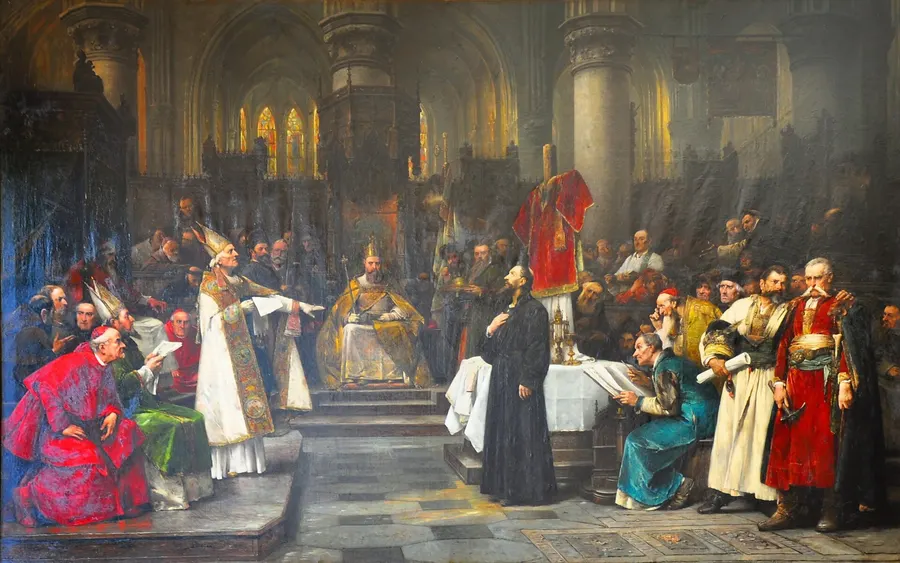
Jan Hus before the Council of Constance, painted by Václav Brožík.Jan Hus before the Council of Constance, painted by Václav Brožík.Image: Václav Brožík · Public domain
culture · Europe

The Council of Constance ends the Great Schism

On 22 April 1418 Pope Martin V formally closed the Council of Constance, which had met by Lake Constance for three and a half years. At one point three men had claimed to be pope at the same time; the council removed them and elected Martin, reuniting the Western Church. It also condemned the Czech reformer Jan Hus, who was burned at Constance in 1415. The council’s claim to stand above the pope fuelled arguments for decades.

Source: Catholic Encyclopedia (New Advent): Council of Constance ↗
III
A CHANGING WORLD

Early Modern Era

Exploration, political change, scientific development and expanding global connections.

1500
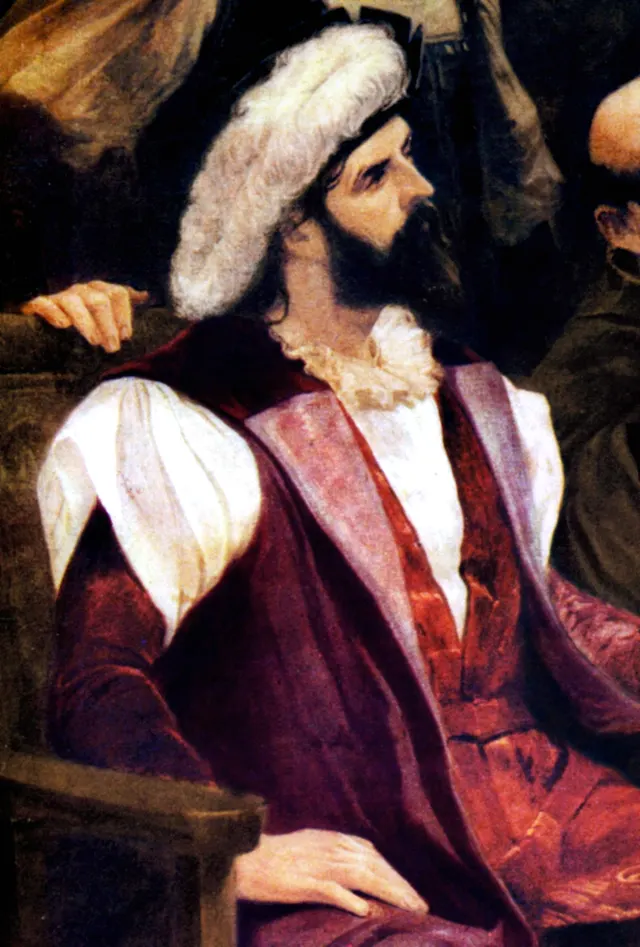
Pedro Álvares Cabral, in a detail from a painting by Aurélio de Figueiredo.Pedro Álvares Cabral, in a detail from a painting by Aurélio de Figueiredo.Image: Aurélio de Figueiredo · Public domain
world · Americas

Cabral’s fleet sights the coast of Brazil

On 22 April 1500 lookouts on a Portuguese fleet bound for India saw a tall, rounded hill rising from the western sea. Pedro Álvares Cabral had swung his 13 ships far out into the Atlantic to catch the winds around Africa, and instead found a coast no European had charted. He named the hill Monte Pascoal and the land the Island of the True Cross, sent a ship home with the news and claimed it for Portugal. The territory later took its name from brazilwood, the red dye timber that became its first export, and Brazil still marks the landing each year.

Source: Biblioteca Nacional (Brazil): 22 de abril de 1500 - Esquadra de Pedro Álvares Cabral chega ao Brasil ↗
1529
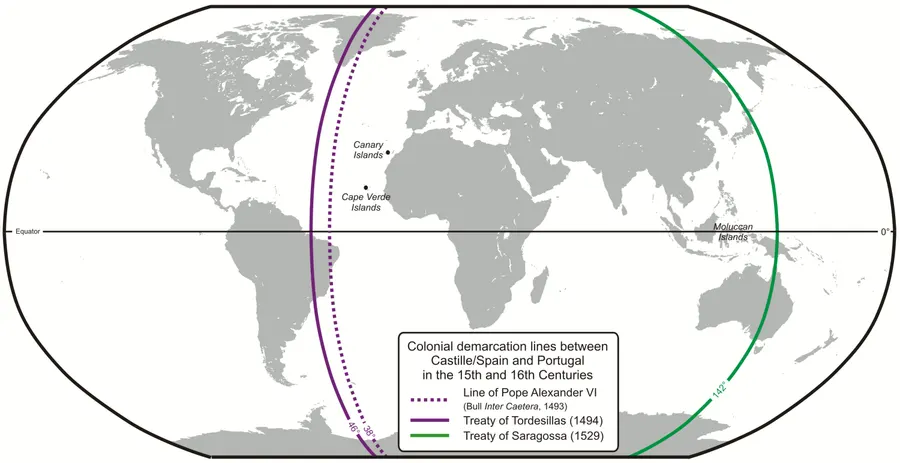
A modern map of the lines dividing the Spanish and Portuguese spheres under the treaties of Tordesillas (1494) and Zaragoza (1529).A modern map of the lines dividing the Spanish and Portuguese spheres under the treaties of Tordesillas (1494) and Zaragoza (1529).Image: Lencer · CC BY-SA 3.0
politics · Asia

Spain and Portugal divide the far side of the world

On 22 April 1529 envoys of Charles V of Spain and John III of Portugal signed a treaty at Zaragoza to end their quarrel over the Moluccas, the Spice Islands of present-day Indonesia. Both crowns had claimed the islands since Magellan’s expedition reached them, because nobody could measure longitude well enough to say whose side of the world they lay on. Spain gave up its claim in return for a large cash payment, and a line was drawn through the Pacific east of the islands. Portugal kept its grip on the clove and nutmeg trade, while Spain went on to settle the Philippines.

Source: Britannica: Treaty of Saragossa ↗
IV
THE NINETEENTH CENTURY

The 1800s

Industry, empire, invention, reform and a century of enormous transformation.

1838
The paddle steamer Sirius, around 1838, by George Atkinson.The paddle steamer Sirius, around 1838, by George Atkinson.Image: George Atkinson Jnr · Public domain
science · Europe

The Sirius steams into New York

On 22 April 1838 the small paddle steamer Sirius reached New York after 18 days at sea from Cork in Ireland, the first ship to cross the Atlantic westward under steam power throughout. The larger Great Western, built for the crossing by Isambard Kingdom Brunel, arrived only hours behind her. The Sirius was a coastal ship pressed into the race and ran very short of fuel, though stories that her crew burned the furniture are exaggerated. The Great Western’s easier passage showed that big steamships could run a regular transatlantic service.

Source: IEEE Spectrum: Crossing the Atlantic ↗
1889
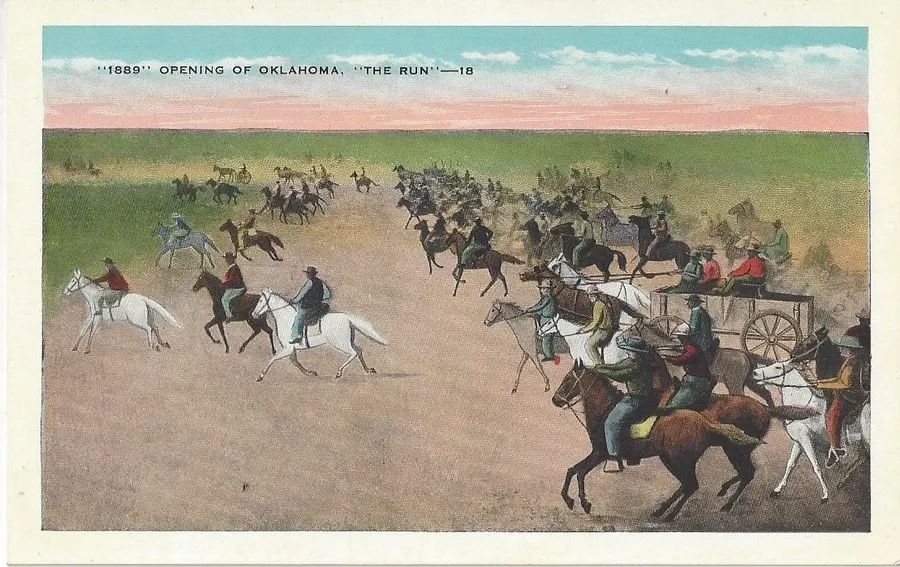
The opening of Oklahoma in 1889, as shown on an early postcard.The opening of Oklahoma in 1889, as shown on an early postcard.Image: Unknown · Public domain
world · Americas

The Oklahoma Land Run

At noon on 22 April 1889 pistol shots, bugles and a cannon signalled the opening of about two million acres of the Unassigned Lands in present-day Oklahoma. Some 50,000 people raced in on horseback, in wagons and by train to claim homesteads and town lots. Guthrie and Oklahoma City grew from empty prairie to tent towns of thousands by nightfall. The land had been ceded by the Creek and Seminole nations after the American Civil War, and the run began the rapid loss of Indian Territory.

Source: Oklahoma Historical Society: Land Run of 1889 ↗
V
THE TWENTIETH CENTURY

The 1900s

War and peace, technological leaps, social change, politics, sport and popular culture.

1915
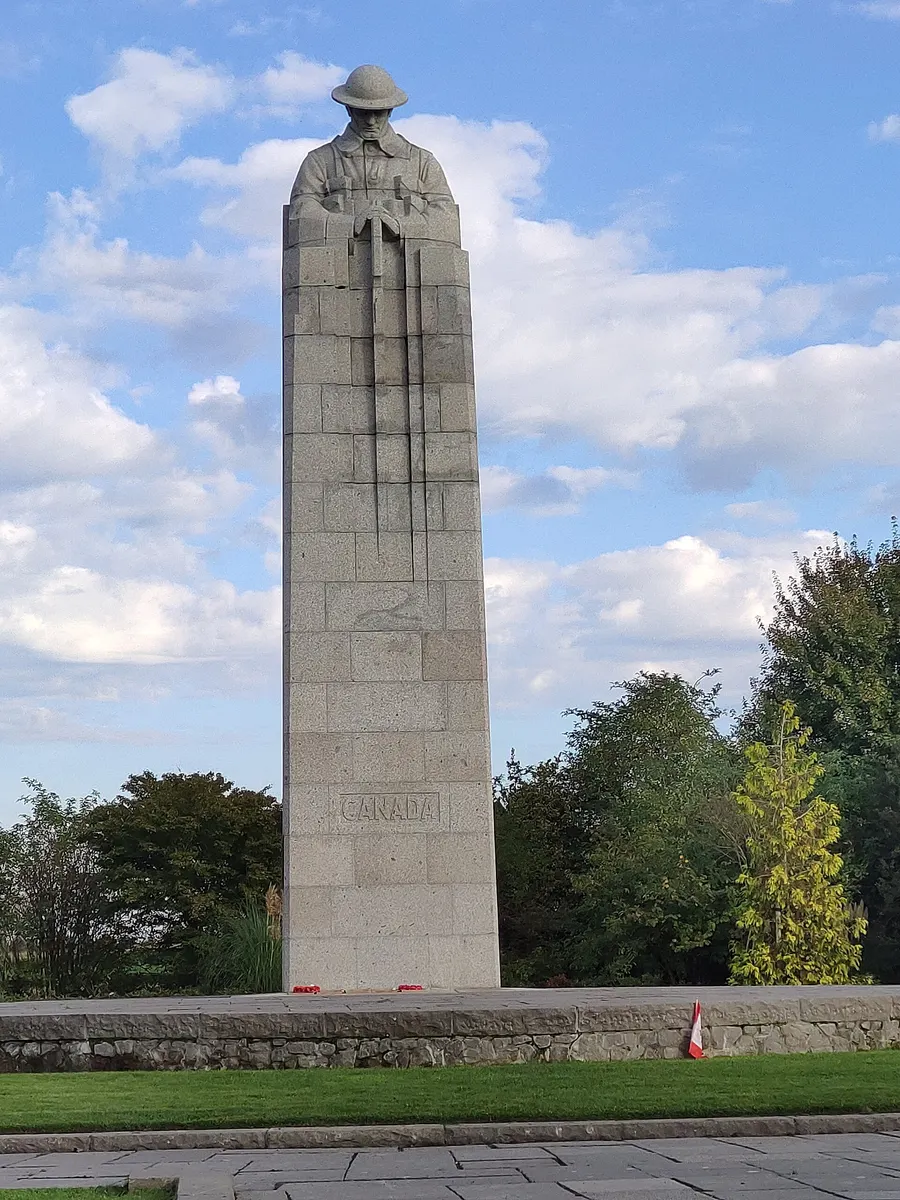
The Brooding Soldier at Saint-Julien, Belgium, Canada's memorial to the men who faced the first gas attacks in April 1915.The Brooding Soldier at Saint-Julien, Belgium, Canada’s memorial to the men who faced the first gas attacks in April 1915.Image: BigBlobfish · CC0
world · Europe

Chlorine gas is released at Ypres

Late on 22 April 1915 German troops opened thousands of cylinders along a stretch of front north of Ypres in Belgium, and a greenish-yellow cloud of chlorine drifted on the wind towards French and Algerian soldiers. It was the first large-scale use of a lethal gas on the Western Front, and it opened a wide gap in the Allied line. The Germans were not ready to exploit the breach, and Canadian and other troops closed it over the following days. Gas masks soon became standard kit, and both sides went on to use chemical weapons for the rest of the war.

Source: Imperial War Museums: What you need to know about the Second Battle of Ypres ↗
1930
Members of the US delegation on their way to the London Naval Conference, around 1929 to 1930.Members of the US delegation on their way to the London Naval Conference, around 1929 to 1930.Image: Admiral William V. Pratt · Public domain
world · Global

The London Naval Treaty is signed

On 22 April 1930 the London Naval Conference ended with a treaty to curb the costly race between the great navies. Britain, the United States and Japan agreed limits on cruisers, destroyers and submarines, and all five powers present extended a pause in building battleships. France and Italy did not accept the tonnage limits. The system collapsed in the mid-1930s as Japan left the treaties and rearmament began.

Source: US Office of the Historian: The London Naval Conference, January 21-April 22, 1930 (FRUS 1930 vol. I) ↗
1945
The entrance to the Sachsenhausen Memorial and Museum.The entrance to the Sachsenhausen Memorial and Museum.Image: Christian Michelides · CC BY-SA 4.0
world · Europe

Sachsenhausen camp is liberated

On 22 April 1945 Soviet and Polish troops reached the Sachsenhausen concentration camp north of Berlin. They found about 3,000 sick prisoners and the doctors and nurses left with them; most other inmates had been driven out on a death march days earlier. Tens of thousands of people had died at the camp since it opened in 1936. The site is now a memorial and museum.

Source: Sachsenhausen Memorial and Museum: Sachsenhausen concentration camp 1936-1945 ↗
1951
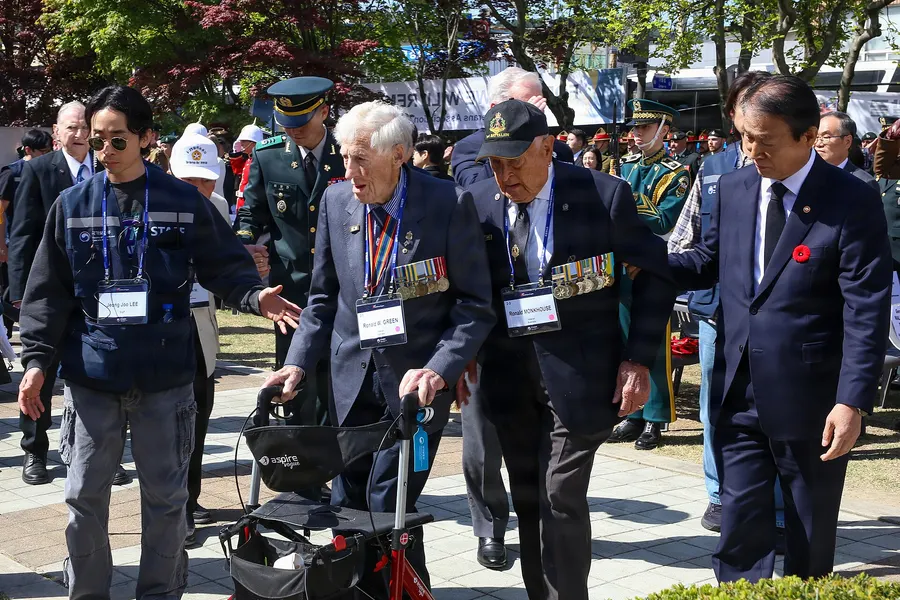
Veterans and UN Command personnel at a commemoration of the Battle of Kapyong in South Korea.Veterans and UN Command personnel at a commemoration of the Battle of Kapyong in South Korea.Image: Pfc. Hyunmin Ahn · Public domain
world · Asia

The Battle of Kapyong begins

On the night of 22 April 1951 Chinese forces opened their spring offensive in Korea, and UN units in the Kapyong valley north-east of Seoul were soon under attack. Australian and Canadian battalions, backed by New Zealand artillery, held their hills for two days against far larger numbers. Their stand helped stop the advance towards Seoul. Both battalions received a US Presidential Unit Citation, and the battle is still commemorated in Australia and Canada.

Source: Australian War Memorial: Kapyong ↗
1969
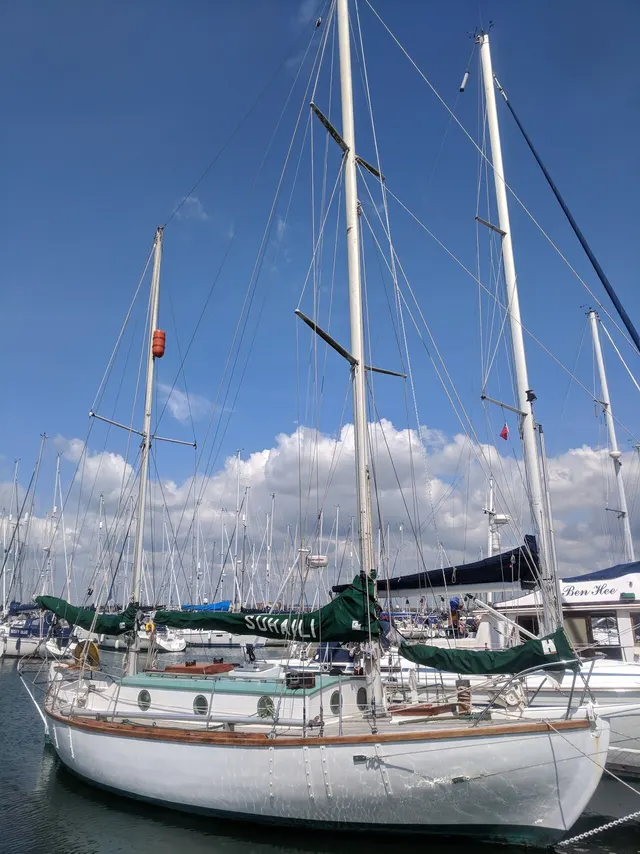
Suhaili, Robin Knox-Johnston's ketch, at Gosport in 2018.Suhaili, Robin Knox-Johnston’s ketch, at Gosport in 2018.Image: Thomas Keyser · CC BY-SA 4.0
sport · Europe

The first solo non-stop voyage round the world

On 22 April 1969 Robin Knox-Johnston sailed his 32-foot ketch Suhaili into Falmouth in Cornwall, 312 days after he had left the same port. He had gone round the world alone without stopping or taking on supplies, something no one had done before. He was the only one of nine starters to finish the Sunday Times Golden Globe Race, having sailed on after losing his self-steering gear in the Southern Ocean. He gave his prize money to the family of a rival who had died at sea.

Source: Royal Museums Greenwich: Suhaili arriving at Falmouth at the end of her non-stop round-the-world voyage (photograph, 22 April 1969) ↗
1970
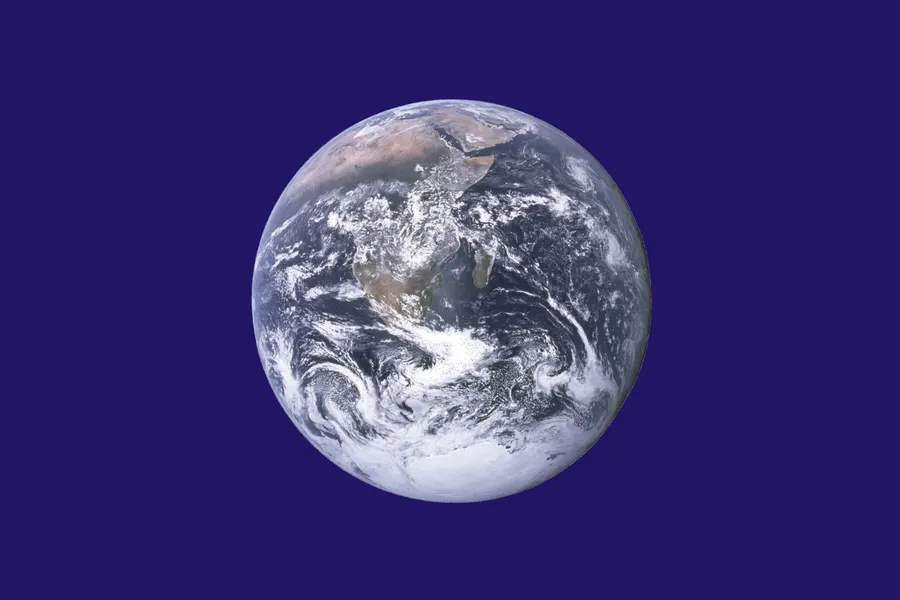
The Earth Day flag designed by John McConnell, using a NASA photograph of the Earth.The Earth Day flag designed by John McConnell, using a NASA photograph of the Earth.Image: John McConnell (design); NASA (Earth photograph); SiBr4 (image) · Public domain
world · Americas

The first Earth Day

On 22 April 1970 an estimated 20 million Americans took part in the first Earth Day, with teach-ins, rallies and clean-ups in schools, colleges and town centres. The idea came from Wisconsin senator Gaylord Nelson, who wanted to turn growing alarm about smog, oil spills and pesticides into a national debate. Within months the US government had created the Environmental Protection Agency, and laws on clean air and water followed. Earth Day spread worldwide and is now marked in almost every country.

Source: US EPA: The Spirit of the First Earth Day ↗
WHY THESE MOMENTS?

Significance before volume

This page is not the longest possible list of events. It is a chronological journey through 22 April, where each entry is chosen for historical significance, human interest and reliability.

Facts are checked against authoritative museums, archives, universities and reference works. Where sources disagree, the page says so.

EXPLORED THE DEEPER STORY?

Return to the highlights of 22 April

Discover the lighter side of the date with famous birthdays, culture, firsts and lives remembered.

Explore This Day →
← PREVIOUS DAY21 April
HISTORY & TIMELINE22 April
NEXT DAY →23 April